

For example, a toddler who doesn’t respond to their name occasionally may just be distracted. But if that happens consistently, along with limited eye contact and reduced interaction, it becomes more meaningful.
Signs of Autism in Toddlers Aged 1
Around the first year, development is less about speech and more about connection.
Parents looking for signs of autism in toddlers aged 1 may notice differences in how their child connects with others, rather than what they say.
You might notice:
- Limited or inconsistent response to their name
- Reduced eye contact during interaction
- Not pointing to show interest
- Not looking back and forth between an object and a person
- Fewer attempts to get your attention
These are early social communication signals. Even before language develops, most children are actively trying to connect. When those signals are reduced, it can be an early indicator.
Signs of Autism in Toddlers Aged 2
By age two, differences often become more noticeable because expectations around communication and play increase.
When looking at signs of autism in toddlers aged 2, parents may notice:
- Delayed speech or very limited use of words
- Not combining words into simple phrases
- Limited use of gestures (pointing, waving, showing)
- Less interest in playing with others
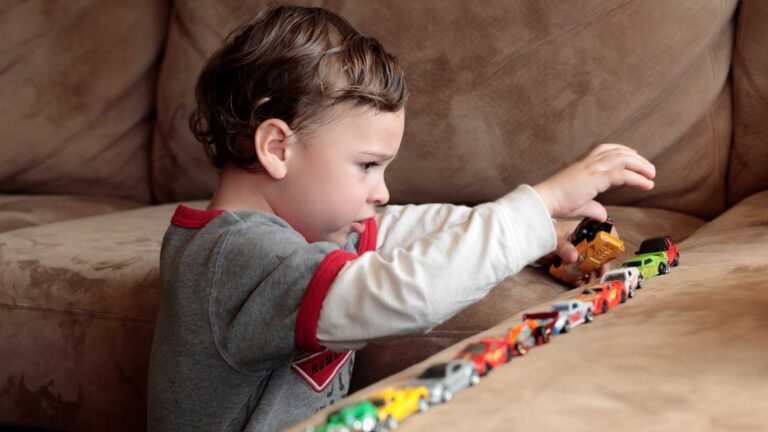
- Repetitive behaviors like lining up toys or repeating actions
At this stage, it’s more about how communication is used. Some children may use some words but do so differently, such as repeating phrases without a clear intent to communicate.
Signs of Autism in Toddlers Aged 3
By age three, social expectations expand further, making differences more apparent.
Common signs of autism in toddlers aged 3 include:
- Difficulty engaging in back-and-forth conversation
- Limited pretend or imaginative play
- Challenges in understanding social cues
- Strong preference for routines or sameness
- Intense reactions to changes or transitions
At this point, differences in interaction and flexibility tend to stand out more clearly than those of peers.
A Side-by-Side Comparison: Typical Development vs Possible Autism Signs
To make things clearer, it helps to see how patterns differ across development:
Area | Typical Development | Possible Early Signs of Autism |
Response to Name | Responds consistently by 12 months | Limited or inconsistent response |
Eye Contact | Uses eye contact to connect and engage | Reduced or avoided eye contact |
Gestures | Points, waves, show objects | Limited or absent gestures |
Play | Expands into pretend and interactive play | Repetitive or focused play (e.g., lining up toys) |
Communication | Uses words and gestures to communicate needs | Delayed, limited, or atypical communication |
Social Interest | Seeks interaction with others | Prefers to play alone or shows limited engagement |
This comparison isn’t meant to diagnose, but to help you recognize patterns.
How to Identify Autism in Toddlers
If you’re trying to understand how to identify autism in toddlers, the key is to look at development as a whole rather than focus on a single behavior.
1. Observe Developmental Patterns
Start by looking at developmental milestones at 2 years and surrounding ages. Focus especially on communication, social interaction, and play, not just speech.
2. Track What Feels Consistent
Is the behavior occasional, or does it happen across different situations? Patterns matter more than isolated moments.
3. Use Developmental Screenings
Pediatricians and child development experts strongly recommend regular developmental screenings. These screenings are typically part of routine check-ups, but you can always ask for them if you have concerns about your child’s development. They help identify early signs of autism more objectively and ensure your child receives support as early as possible.
4. Talk to Your Pediatrician
Bring specific examples of what you’re seeing. This helps move the conversation from general concern to actionable next steps.
5. Schedule a Comprehensive Evaluation
If early signs of autism in toddlers are consistent, the next step is a formal evaluation. This provides a clearer understanding of your child’s development and what kind of support may be helpful.
6. Focus on Understanding, Not Labeling
The goal isn’t just a diagnosis, it’s clarity. Knowing how your child learns and interacts allows you to support them more effectively.
Why Early Signs of Autism in Toddlers Are Sometimes Missed
One of the reasons parents hesitate is that many early signs of autism in toddlers can be explained in other ways.
A child may be described as:
- “Independent”
- “Quiet”
- “focused”
- “A late talker”
And sometimes, that’s true.
But when multiple signs appear together, especially across communication and interaction, it’s important not to dismiss them too quickly.
Recognizing early signs of autism in toddlers doesn’t mean jumping to conclusions, but paying attention to patterns.
How ABA Therapy Supports Social and Communication Development

When a child shows early signs, the goal is not to “fix” behavior; it’s to build skills.
ABA therapy is one of the most widely used approaches to support toddlers on the spectrum because it focuses on how children learn in real-life situations.
Instead of working on isolated tasks, ABA therapy helps children:
- Learn to respond to their name
- Develop joint attention (sharing focus with others)
- Build communication step by step
- Engage in back-and-forth interaction
- Expand play in more flexible ways
When It’s Time to Talk to Someone
Many parents wait because they’re unsure if their concern is “big enough.”
But if you’ve been noticing patterns, especially across different areas of development, it’s worth having a conversation.
At ABA Centers of Rhode Island, families often reach out during this exact stage. Not because they’re certain, but because they want clarity.
If you’d like to talk through what you’re seeing or better understand how to identify autism in toddlers, contact us online or call (855) 922-4184 to connect with a specialist.
Recognizing early signs of autism in toddlers doesn’t mean jumping to conclusions. It means making informed decisions without guessing.